

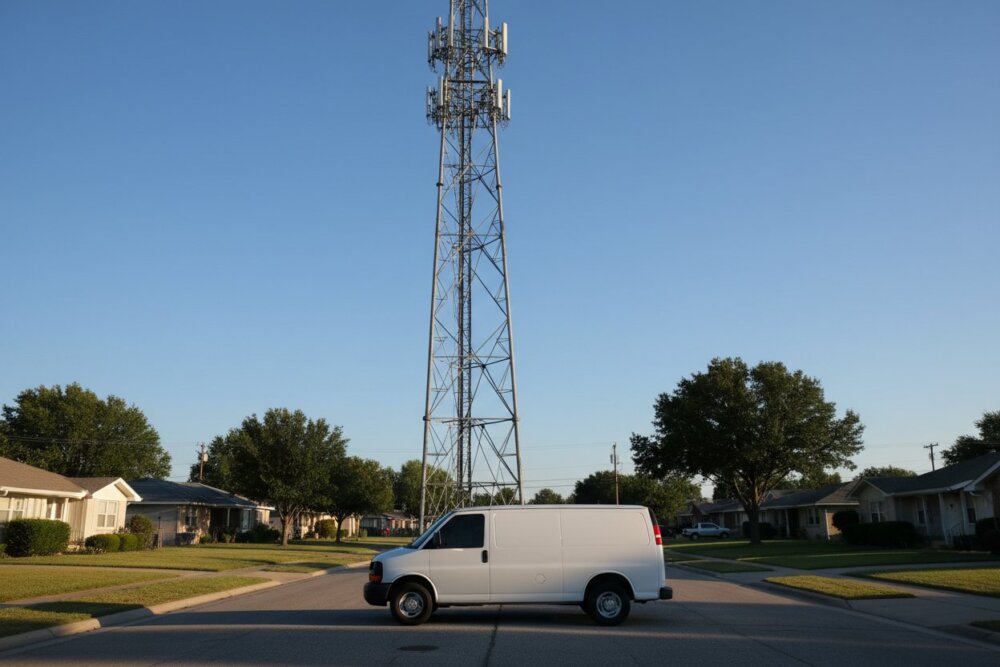
Quick answer: A stingray is a surveillance device that impersonates a real cell tower to trick nearby phones into connecting to it. Once your phone connects, the operator can capture your phone’s unique identifiers, pinpoint your location, and in some cases downgrade your connection to intercept data. Stingrays are also called IMSI catchers or cell-site simulators. For most people the practical defenses are keeping your phone updated, disabling 2G, using encrypted apps, and turning on your phone’s strongest security mode.
You may have heard the word “stingray” in a news story about police surveillance or a spy thriller and wondered whether it is something you actually need to worry about. Here is a plain-English explanation of what these devices are, how they work, and what you can realistically do about them.
Last Updated: September 2026 · Written by Samuel Smith, a consumer technology writer and digital-privacy researcher who explains phone-surveillance threats in plain English for non-technical readers.
From experience: Fake cell towers are real, but for the average person they’re not something to worry about day to day — they’re mainly a concern in targeted surveillance situations, around certain sensitive events, or if you have a specific reason to believe someone is trying to identify or track your phone.
What Is a Stingray?
A stingray is a type of IMSI catcher, which is a device that pretends to be a legitimate cell tower. The name “Stingray” originally comes from a specific product line, but it has become a catch-all term. Security researchers usually call these devices cell-site simulators. The “IMSI” part stands for International Mobile Subscriber Identity, the unique number tied to the SIM card in your phone.
In short: a stingray is a fake cell tower on wheels, in a backpack, or in a car. It broadcasts a strong signal so nearby phones latch onto it, mistaking it for the real network.
How a Stingray Works
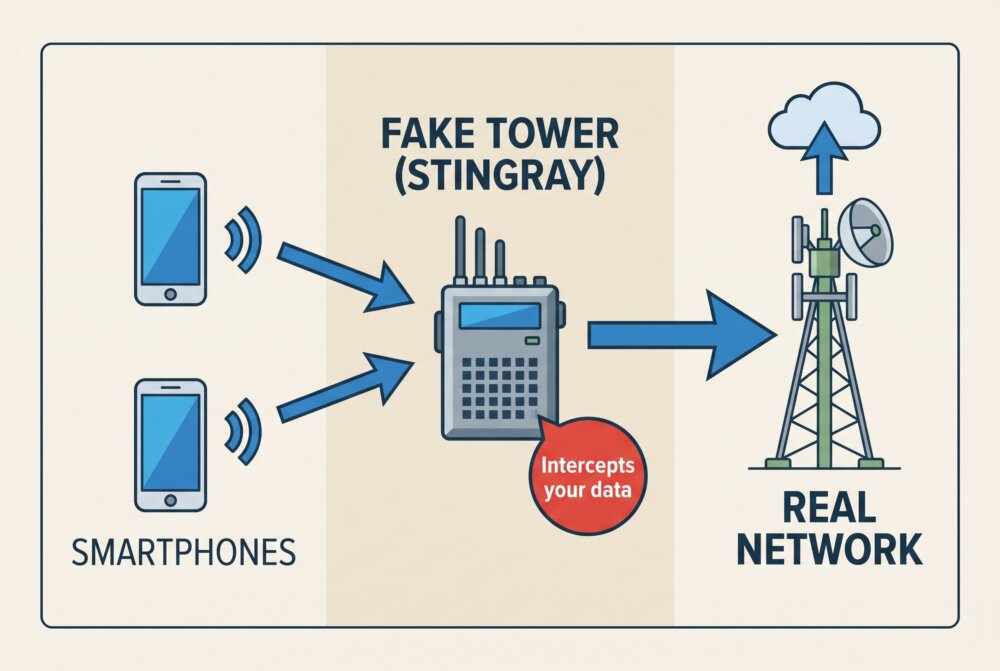
The attack relies on a weakness in how phones were originally designed. Your phone is built to connect to whichever cell tower has the strongest signal, and in older network protocols the tower does not have to prove it is genuine before your phone trusts it. A stingray exploits that by broadcasting a powerful signal that overpowers real towers nearby.
Once your phone connects, the device can do several things depending on its capabilities:
- Harvest identifiers. It grabs your IMSI and other IDs, which effectively confirms your phone, and by extension you, is in the area.
- Locate you precisely. By measuring your signal, it can pin your position far more accurately than a normal tower.
- Force a 2G downgrade. Older 2G connections have weak or no encryption. A stingray can push your phone down to 2G, where intercepting metadata or content becomes easier.
Because it sits between your phone and the real network, a stingray is a form of man-in-the-middle device for the cellular world.
Who Uses Stingrays?
Historically, cell-site simulators have been associated with law enforcement and intelligence agencies. Civil-liberties groups like the Electronic Frontier Foundation have documented their use extensively. The bigger modern concern is that the technology has gotten cheaper and more available, which raises the possibility of misuse by parties other than official agencies. For the average person, the day-to-day risk is low, but if you are a journalist, activist, or someone in a high-conflict situation, it is worth understanding.
Can You Detect a Stingray?
Detection is hard for ordinary users, because a stingray is designed to look like a normal tower. That said, a few signals hint at one being nearby:
- Your phone suddenly drops to 2G in an area with normally strong 4G or 5G.
- Unusual, repeated loss of service or forced reconnections in a specific spot.
- Rapid battery drain paired with connectivity oddities.
There are specialized tools built for detection. The EFF released an open-source project called Rayhunter to help spot cell-site simulators, and researchers have built other apps like SnoopSnitch for certain Android hardware. These are technical tools, not one-tap consumer apps, so treat them as advanced options rather than everyday protection.
How to Protect Yourself
You cannot stop a stingray from broadcasting, but you can make your phone a much harder and less useful target:
- Disable 2G. Both iPhone and Android let you restrict or turn off legacy 2G in newer versions. This blocks the classic downgrade trick. On Android, look under network settings; iPhone’s Lockdown Mode disables 2G among other protections.
- Turn on your phone’s strongest security mode. iPhone’s Lockdown Mode and Android’s Advanced Protection reduce the attack surface for high-risk users.
- Use end-to-end encrypted apps. Even if metadata is exposed, apps like Signal keep the content of your messages and calls encrypted, so an interceptor sees far less.
- Keep your phone updated. Security patches close many of the flaws these devices lean on.
- Use a VPN on data connections. A VPN encrypts your internet traffic, which limits what an interceptor can read. See our guides on the best VPN for iPhone privacy and the best VPN for Android privacy.
For the times you want to be completely off the grid, slipping your phone into a Faraday signal-blocking pouch cuts the cellular signal a stingray relies on, so your phone can’t connect to any tower — real or fake — while it’s inside.
How Stingrays Compare to Other Phone Threats
A stingray targets your connection to the network, but it is only one item on a longer list of ways a phone can be spied on. Advanced spyware like Pegasus attacks the phone itself, SIM swapping hijacks your phone number through your carrier, and everyday phone hacking usually happens through malicious apps or stolen passwords. For most people, those threats are far more likely than a fake cell tower, so lock those down first.
A Note on Safety
If your concern about surveillance is tied to an abusive partner, ex, or stalker, please know that the most common tracking methods in those situations are stalkerware apps, shared accounts, and physical trackers, not stingrays. Help is available. The National Domestic Violence Hotline can be reached 24/7 at 1-800-799-7233, and the National Network to End Domestic Violence (NNEDV) Safety Net project offers practical technology safety planning.
Related reading: how to tell if your SIM card has been cloned.
Frequently Asked Questions
What is a stingray device in simple terms?
A stingray is a fake cell tower. It broadcasts a strong signal so nearby phones connect to it instead of the real network, letting the operator identify phones, locate them, and sometimes intercept communications. It is also called an IMSI catcher or cell-site simulator.
Can a stingray read my text messages?
Some cell-site simulators can capture metadata or force a phone onto weakly encrypted 2G where interception is easier. However, messages sent through end-to-end encrypted apps like Signal remain protected even if the connection is intercepted, because the content is encrypted on your device.
How do I know if a stingray is tracking my phone?
There is no reliable one-tap check for regular users. Warning signs include your phone unexpectedly dropping to 2G, repeated forced reconnections in one location, and connectivity glitches with fast battery drain. Advanced tools like the EFF’s Rayhunter exist but require technical setup.
Can you block a stingray?
You cannot stop the device from transmitting, but you can protect your phone by disabling 2G, enabling Lockdown Mode or Advanced Protection, using encrypted messaging apps, keeping software updated, and using a VPN. These steps make your phone a far less useful target.
Does airplane mode stop a stingray?
Yes, while airplane mode is on your phone will not connect to any tower, real or fake, so a stingray cannot capture it. The trade-off is that you also lose all calls, texts, and data during that time.
Are stingrays legal?
In the United States, use of cell-site simulators is generally restricted to authorized law enforcement and government agencies, often requiring legal authorization. Use by private individuals is heavily restricted. Rules vary and continue to evolve, so this is not legal advice.
Samuel Smith is a consumer technology writer and digital-privacy researcher with more than a decade covering smartphones, apps, and online security, known for turning complex privacy topics into plain-English, tested advice for everyday people. He follows how surveillance tools like fake cell towers really work and what they mean for ordinary phone users, so readers get perspective instead of panic.